I’m on a quest to explore the use of the Bible in Christian discourse on LGBTQIA+ issues. These explorations are exercises in testing the traditional view of marriage and gender. As a theologian with a genuine appreciation for the Christians theological tradition, I think it’s important to take a teaching or two off the shelf occasionally and give it the once-over.
One passage that is foundational for the traditional view is Matthew 19:4-5.

In the preceding verses, Pharisees have asked Jesus to talk about the law of divorce found in Deuteronomy. Jesus responded with texts from Genesis 1 and 2:
“He answered, “Have you not read that the one who made them at the beginning ‘made them male and female,’ and said, ‘For this reason a man shall leave his father and mother and be joined to his wife, and the two shall become one flesh’?” (NRSV)
According to proponents of tradition, this passage reveals two vital, divinely certified facts about human nature:
- Valid marriage is between one man and one woman.
- There are exactly two genders, each human being possessing one or the other exclusively.
Although this belief about the passage has the force of tradition, it needs examining. Let’s focus on the quotation from Genesis 2 (“For this reason a man shall leave his father and mother and be joined to his wife, and the two shall become one flesh”). It is curious to me that this verse is regarded as a literal description of fact, given that it occurs in a story that many Christians are happy to take with a grain of salt. Some of the more fantastic elements of Genesis 2 include:
- A tree whose fruit instantaneously confers knowledge of good and evil.
- Childbirth without pain.
- Earth without weeds.
- Rivers (the Tigris and the Euphrates) that somehow emerge from the universal, cataclysmic flood (Gen. 6) in exactly their original location.
- Unexplained people: Whom did Cain marry (Gen. 4:17)? Who are the people of whom Cain was afraid (Gen. 4:14)? As Genesis tells it, the story of Cain takes place when there are just three people on the earth.
- Humans appearing as the first animals.
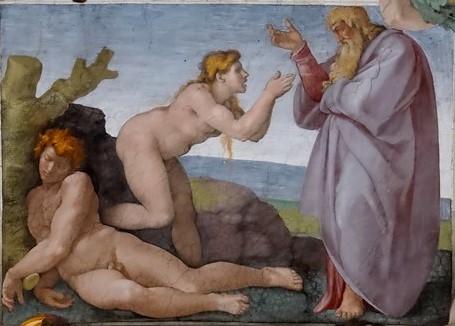
Except for Fundamentalists (whether naive or informed), Christians don’t take the story of Genesis 2 as a literal account of the past. They are willing to see it as largely or wholly symbolic, except when it comes to verse 24 (“For this reason a man shall leave his father and mother and be joined to his wife, and the two shall become one flesh”). Suddenly, for advocates of the traditional view of marriage and gender, we are in the realm of Absolute Truth.
This claim to Absolute Truth, however, becomes suspicious when we realize that “a man shall leave his father and mother and be joined to his wife” precisely because Eve was created from Adam’s rib (or side or whatever the word means). Am I alone in thinking that basing the traditional view of marriage (one man and one woman) on Eve’s being created from a rib is a shaky proposition?
Perhaps what is most important for traditionalists is the fact that Jesus quotes these texts from Genesis. There are plenty of OT passages that Christians ignore, but if Jesus cites one of them, it must be important, right?
Maybe, but there are OT passages that Jesus quotes that fall into the “who cares?” category for most Christians:
- “Is it not written in your law, ‘I said, you are gods’? If those to whom the word of God came were called ‘gods’—and the scripture cannot be annulled…” (John 10:34-35 NRSV, quoting Psalm 82:6).
- “For I have come to set a man against his father, and a daughter against her mother, and a daughter-in-law against her mother-in-law, and one’s foes will be members of one’s own household” (Matthew 10:35-36 NRSV, quoting Micah 7:6). (I always wondered how this verse accorded with Evangelical’s fondness for family values.)
- “And he said to them, “To you has been given the secret of the kingdom of God, but for those outside everything comes in parables, in order that ‘they may indeed look but not perceive, and may indeed hear but not understand; so that they may not turn again and be forgiven’” (Mark 4:11-12 NRSV, quoting Isaiah 6:10).
I’ve never heard a pastor seriously engage any of these passages. I think this means that the mere fact that Jesus quotes from the OT does not mean that those OT passages assume great importance in Christian thinking. Something else must explain the prominence of this quotation in Matthew 19.
That something, of course, is the dread that conservative Christians in America feel when they perceive any deviation from traditional views of marriage and gender. It is that dread that causes this verse to bear the interpretive weight that conservatives load upon it. The importance of Matthew 19:4-5, in other words, may owe more to Evangelicals’ anxiety about the decline and fall of the American empire than to carefully applied hermeneutics. (At the same time, I fully acknowledge that non-traditionalists have their own social concerns that guide, perhaps dictate, their use of the Bible.)
It is worth exploring the immediate context of Matthew 19:4-5. The fact that Jesus is here responding to a question about divorce is likely important to interpreting these verses. That, however, is a task for another post.
Image attribution
- Christ among the Pharisees Pharisees Public Domain Mark 1.0
- Creation of Eve Attribution 2.0 Generic (CC BY 2.0)
 samuelmpowell.com